Buy 3CX Licenses: Editions, Seat Sizing, and Renewal Tips

Buying a 3CX license looks simple at first, then the details show up fast. The edition affects features, the size affects capacity, and the renewal path affects whether the system stays stable over time. For small and mid-size businesses, that combination matters more than a flashy price point.
A smart purchase starts with three clear questions: What features does the business need now? How many calls happen at the same time? What should happen at renewal, especially if growth, hosting changes, or AI features are on the table? When those answers are clear, buying 3CX becomes much easier and much more cost-effective.
3CX license editions for business phone system needs
3CX licensing is not one-size-fits-all. Official 3CX editions commonly discussed for business buyers include Basic, PRO, Enterprise/AI, and in some cases ENT+ for more specialized AI and transcription needs. A free entry-level option may exist for very small deployments, though most growing companies shopping for a production phone system end up comparing the paid editions.
The fastest way to separate them is to think in terms of business use. Basic covers core telephony. PRO adds the features many active SMBs actually want. Enterprise/AI is the step up for resilience, deeper analytics, and newer AI functions.
| Edition | Best fit | What stands out | What to watch | |—|—|—|—| | Basic | Budget-focused teams that want core calling | Lower cost, secure PBX, intercom, paging, basic reports | No queues, CRM, recordings, Teams, or AI features | | PRO | Growing SMBs and customer-facing teams | Queues, reports, wallboards, CRM tools, WhatsApp, SMS, live chat | Less built-in resilience than Enterprise | | Enterprise / AI | Larger or higher-volume organizations | AI receptionist, transcription, summaries, failover, standby licensing, stronger analytics | Higher annual cost | | ENT+ | Specialized AI or compliance-heavy requirements | Premium transcription and AI profile for select license sizes | Narrower fit than PRO or standard Enterprise |
For many organizations with more than five employees, PRO lands in the sweet spot. It gives the business phone system room to work like a real customer communications platform instead of a simple PBX. Queues, reporting, CRM integrations, and messaging features often become valuable faster than expected.
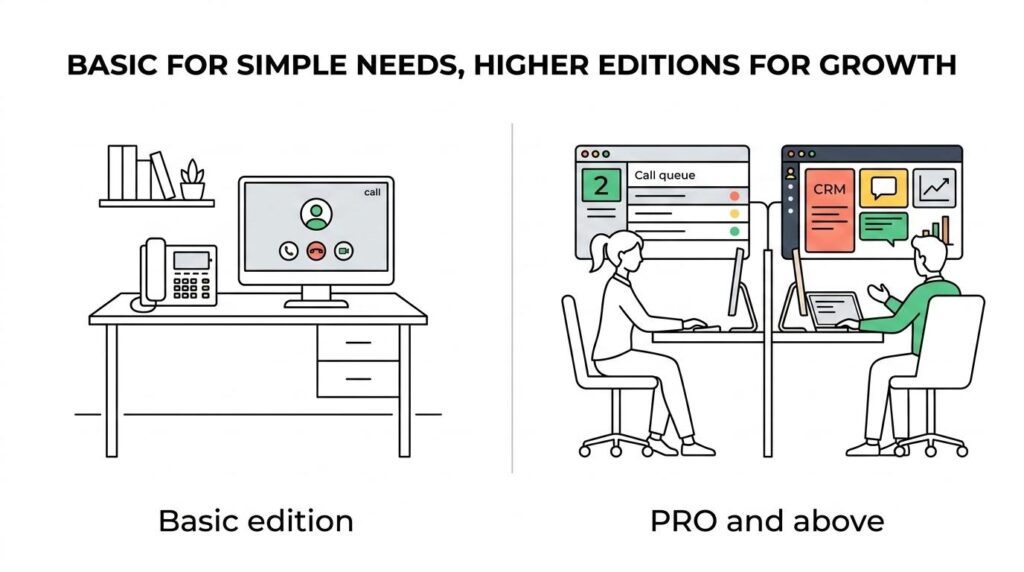
Basic still has a place. It can be a good fit when the business wants dependable calling and nothing more. That often applies to offices with simple call flow, low reporting needs, and little interest in chat, AI, or contact center tools.
After the edition discussion, the decision usually becomes clearer:
- Core phone service only
- Light internal call handling
- No queue management
- No CRM or Teams link
- Minimal reporting needs
When those points describe the environment, Basic can work well. When they do not, PRO is usually the safer buy.
3CX seat sizing based on simultaneous calls
One of the biggest buying mistakes happens before checkout. 3CX is not mainly licensed by user seat in the same way many cloud phone platforms are. It is licensed by simultaneous calls, often shortened to SC. That means the number of employees matters, but it is not the whole story.
A 20-person office does not always need the same license size as another 20-person office. One may only have a receptionist and occasional outbound calls. Another may have a support queue, active transfers, mobile users, and a front desk that is busy all day. Same employee count, very different call patterns.
3CX publishes recommended user ranges tied to simultaneous call tiers, and those ranges are a strong starting point for sizing. They are not a substitute for real call behavior, though. Peak traffic matters more than averages.
| Approximate user range | Common starting point | |—|—| | 1 to 10 users | SMB / very small deployment | | 11 to 25 users | 8SC | | 26 to 50 users | 16SC | | 51 to 70 users | 24SC | | 71 to 120 users | 32SC | | 121 to 160 users | 48SC | | 160 to 200 users | 64SC |
This table is useful, but it should be treated as a guide, not a shortcut. A business with heavy inbound traffic, frequent transfers, and active internal calling may need more room. A quieter office may stay comfortable within the lower end of the range.

A stronger sizing review usually includes these checks:
- Peak traffic: Count the busiest hour, not the average hour.
- Internal calls: Transfers and staff-to-staff calls count toward simultaneous calls too.
- Queues: Support, sales, dispatch, and reception teams can push concurrency much higher.
- Remote users: Mobile and web app usage can increase active call demand.
- Recording and AI use: Heavier workloads may affect both system design and edition choice.
- Growth plans: A system expected to expand within a year should not be sized too tightly.
That last point is easy to miss. Saving a small amount on day one can lead to a rushed upgrade later. 3CX can be upgraded in place, which helps, but a little planning still goes a long way.
3CX license buying questions before purchase
A strong 3CX purchase usually comes from asking operational questions, not only pricing questions. The business should know whether it wants on-premise, hosted, or cloud migration support. It should know whether the phone system needs to connect to CRM tools, Microsoft Teams, reporting platforms, or AI features.
That is where many SMBs benefit from working with a focused 3CX partner instead of buying only on raw SKU logic. The right quote depends on what the company is trying to do with the system over the next 12 to 24 months.
A pre-purchase review should cover:
- Current number of users
- Busiest-hour call volume
- Need for queues and supervisor reporting
- CRM, Teams, or SMS requirements
- Remote workforce needs
- Hosting or cloud migration plans
- AI transcription or summaries
If the business already runs 3CX, the review should also include the current version, existing hosting model, and any pain points in administration. Those details often shape whether a simple renewal is enough or whether a move to a new edition makes more sense.
3CX renewal tips that prevent last-minute problems
Renewal is not just a billing event. It is the checkpoint where businesses can fix under-sizing, add needed features, and make sure hosting or version issues do not interrupt service. Waiting until the last few days creates risk that is easy to avoid.
For most organizations, 30 days before expiration is a good starting point. If the business may change editions, move from on-premise to cloud, or increase capacity, 45 to 60 days is a better window. That gives enough time to review the system, confirm licensing details, and handle any technical changes cleanly.
Renewal is also when teams should ask whether the current edition still fits. A company that bought Basic two years ago may now need queues, reporting, CRM links, or AI features. A company that sized tightly may now be running too close to its real concurrent call demand.
A practical renewal checklist looks like this:
- Start early: Routine renewals are easier when they begin at least a month ahead.
- Check the system version: Older builds may need updates before renewal-related work is handled smoothly.
- Review hosting status: Some smaller hosted scenarios can have limits if service lapses.
- Recheck license size: Growth, new departments, and busier call periods may justify a larger SC tier.
- Review edition fit: Renewal time is often the right time to move from Basic to PRO, or from PRO to Enterprise/AI.
There is also a financial angle here. 3CX subscriptions can often be upgraded in place, with the price difference applied rather than forcing a full reset of the license path. That makes renewal a good moment to correct earlier compromises without wasting prior investment.
Hosted 3CX licenses and cloud migration options
Buying the license is only one part of the system plan. Many businesses also need to decide where 3CX will live. Some want to keep control with self-hosting or an on-premise server. Others want a hosted setup that reduces day-to-day telephony administration.
Hosted 3CX is often attractive for companies that have limited internal telecom expertise, distributed teams, or a clear push toward cloud infrastructure. It can also make sense for organizations that want a cleaner migration path from an older on-premise system.
This is one of the areas where a 3CX-focused provider can bring real value. We are VoIP offers 3CX licenses, hosting services, and a one-time 3CX system checkup. That gives businesses a practical path whether they need a new deployment, a renewal review, or help moving an existing on-premise system into the cloud.
The best hosted choice depends on the same core questions that shape the license itself:
- Control: Self-hosting may suit IT teams that want direct platform ownership.
- Support: Hosted service can reduce routine administration for leaner teams.
- Migration: Cloud moves are easier when the provider already works with 3CX licensing and hosting together.
- Optimization: A system checkup can identify sizing issues, feature gaps, and cleanup opportunities before renewal.
For companies interested in 3CX AI features, the hosting conversation can matter even more. Transcription, summaries, reporting, and newer AI workflows are easier to plan when the edition, infrastructure, and ongoing support model are reviewed together.
When a 3CX partner helps most with buying and renewals
Some businesses have an in-house IT team and still want partner support. That is common with 3CX because licensing, hosting, SIP setup, feature planning, and renewals cross several operational areas at once. Other businesses simply want a provider to handle the moving parts without turning every small change into an internal project.
A partner becomes especially useful in a few situations. One is when the current system feels underused, with features sitting idle because no one has time to tune them. Another is when the business wants to add AI, reporting, or integrations but needs a clean plan first. A third is when renewal is coming up and no one is fully sure whether the current edition or size still fits.
That is why a simple health review can be a smart first step. A focused checkup can reveal whether the business is paying for too much, running too tight, or missing features that would improve service and reporting. For buyers considering a new license, it can also turn a vague quote request into a clear buying decision.
A 3CX license is easier to buy when the process stays grounded in business use, call volume, and renewal timing. That is the difference between purchasing a code and putting a phone system in place that stays useful well after the first invoice.
Ready to Optimize Your 3CX System?
Get expert guidance with our $49 system checkup.